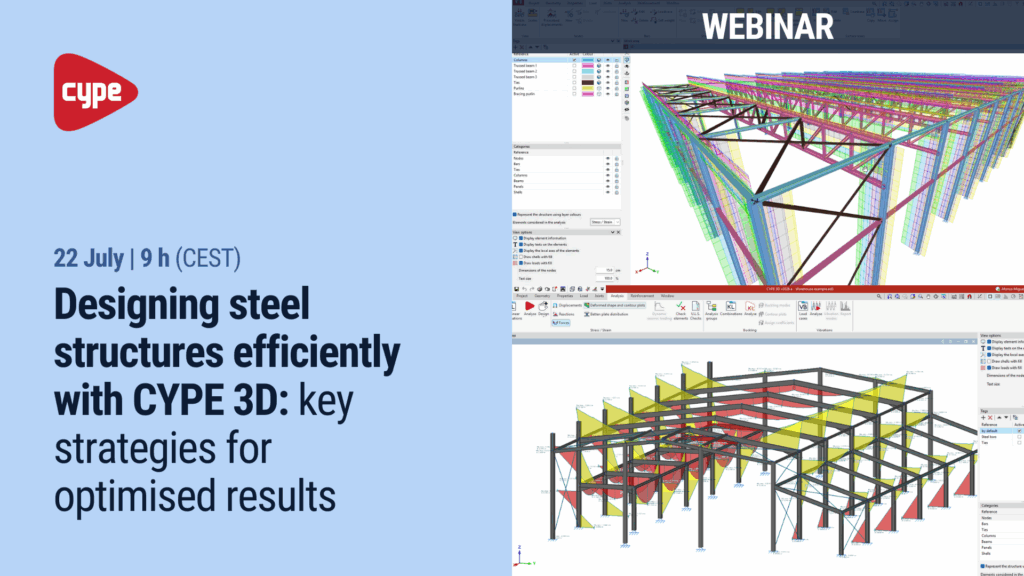


Join this webinar and discover how to reduce time and costs in structural design thanks to CYPE 3D's advanced verification and modelling tools.
Contents of the webinar:
- Basics of structural optimisation
Introduction to CYPE 3D and key concepts for optimising steel structures: safety, efficiency and economy.
Selecting codes and defining loads. - Structural modelling
Modelling tools in CYPE 3D, import from DWG/DXF, use of Portal frame generator and use of the "sketch" tool in CYPE Architecture. - Selecting and optimising sections
Section libraries (IPE, HEA, HEB, tubular sections), buckling configuration, slenderness and stiffness checking and automatic optimisation of sections according to codes. - Entering loads
Viewing loadcases, entering loads on nodes, bars and shells, and automatically generating the self-weight. - Results and documents
Analysis reports, project sheets and drawings; and estimates of material quantities. - BIM integration and additional resources
Expanding the workflow with CYPE Connect, StruBIM Steel.
Possibility of integrating CYPE 3D structures in CYPECAD.
Coordination with foundations and interference checking. - Common mistakes and frequently asked questions
Solving typical analysis problems, processing times and regulatory verification.
Target group:
- Structural engineers and consultants.
- Architectural firms.
- Professionals interested in integrating BIM tools such as CYPE 3D and StruBIM Steel into their workflows.
What makes CYPE 3D version 2026 stand out?
CYPE 3D is an advanced solution for the design and analysis of steel structures, aimed at optimising both the structural performance and the constructive and economic efficiency of projects. It combines the power of design with an intuitive interface and versatile modelling tools, all backed by a solid regulatory base, making it an essential ally for engineers and designers looking for precision, economic efficiency and agility.
The concept of optimisation in steel structures covers three essential pillars: safety, efficiency and economy. CYPE 3D makes it possible to address these aspects holistically, making it straightforward from the very beginning to select the appropriate codes and define the most suitable structural type for each case. In addition, it includes tools that help define realistic loads and combinations, taking into account the expected structural behaviour and regulatory requirements.
In the modelling phase, the program offers multiple options for defining the geometry of the structure quickly and accurately. Users can work from scratch with the internal drawing tools, import geometries from DWG/DXF files, or use the Portal frame generator program, developed for the automatic generation of portal frames. The CYPE Architecture environment also allows users to create a preliminary sketch that can be used as a basis for defining the structure.
One of the most powerful features in CYPE 3D is its ability to select and optimise sections. The program includes a comprehensive library of sections (IPE, HEA, HEB, tubes, among others), as well as a wide range of section series from manufacturers in different countries. Users can set buckling lengths, analyse slenderness and stiffness, and apply automatic optimisation tools to choose the most suitable section in compliance with current regulations, minimising weight and reducing costs.
When it comes to entering loads, CYPE 3D can be used to define multiple loadcases and load conditions, as well as automatically generate combinations. The program automatically analyses the self-weight of the structure and makes it easy to assign loads to nodes, bars and shells intuitively, with full control over their distribution and magnitude. The results obtained after the analysis are detailed, clear and ready for technical or documentary use. The program automatically generates regulatory reports, project drawings, graphic shells and an accurate estimate of materials, providing a complete overview of structural behaviour and construction planning.
Furthermore, CYPE 3D integrates seamlessly into collaborative workflows in a BIM environment. The structures generated can be complemented with tools such as CYPE Connect, for the design of connections, and StruBIM Steel, for detailed modelling in a 3D environment. The model can also be exported to CYPECAD to be integrated into mixed projects or to design foundations based on the model generated. All of this promotes multidisciplinary coordination, interference detection and improved overall project control.